Mosaic Heist / Game rules
HOW IT WORKS
One shared canvas. A new round when the board fills. Every round keeps its own pot, result and winner NFT.
The public release remains read-only. A separate Robinhood testnet deployment completed a full-board draw; it is paused and is not connected to public purchases. Live prize withdrawals, NFT and Crew minting are still pending Vault activation and verification. Randomness security, release contract pricing and wallet checks are not yet approved for public play. The rules below do not create an active mint entitlement.
A canvas that keeps moving
Board
100 x 100
Pixels
10,000
Filled round
Next opens
Each purchase claims distinct pixels in the current round. A pixel cannot have two owners. Your wallet has a stable display color; that color does not change your odds, and colors are not guaranteed to be unique across all wallets.
The final valid purchase fills the board, closes that round and opens the next one in the same transaction. The new board starts with its own ownership, wallet limits and pot. A new round opening does not mean the previous prize has already been paid.
Rounds also have a configured deadline. An unfilled expired round needs an advance transaction before the next one opens; time alone cannot submit it. That expired round becomes refundable. The deployment fixes the timeout for the sequence, with a 24-hour default.
Quick Buy or Manual Pick
QUICK / 0.0004 ETH
Per pixel, paid in ETH. The backend assigns available pixels and binds the assignment to your signed purchase. A Quick quote expires after 60 seconds.
MANUAL / 0.0008 ETH
Per pixel, paid in ETH. You choose the positions, including pixels selected by drawing. Manual purchases use a commitment and a minimum three-contract-block delay. Quotes expire after 300 seconds.
Prices are fixed in ETH, not pegged to dollars. No ETH/USD price service is used. Your ETH payment stays the same when the dollar exchange rate changes; network gas is separate.
Core locks both prices before its first round. Every signed purchase must match those on-chain prices exactly. A missing or mismatched contract price, stale network state or expired quote blocks purchases. Changing an existing price policy requires a new deployment, not an edit to a quote.
The pot and prizes are paid in ETH at the unchanged allocation below. A full board of 10,000 paid Quick pixels at 0.0004 ETH collects 4 ETH: 2.7 ETH Grand, 0.6 ETH platform and 0.7 ETH buyback treasury. Manual purchases and free entries change the total collected, not the percentages.
- Per transaction
- 1-50 pixels
- Per wallet, per round
- 250 pixels
- Manual price premium
- Position selection, not better per-pixel odds
- An unconfirmed signature
- Not a purchase and not ownership
Pixel purchases are entries in the game, not individual ERC-721 NFTs. Only the Grand winner can mint that round's canvas NFT. Paid purchases and bonus pixels, when enabled, share the same board capacity and wallet cap.
Where the pot goes
The split applies to ETH actually collected, excluding network fees. Free pixels do not add payment to the pot. A full board can therefore have a different pot depending on paid purchase modes and bonus participation.
- Grand prize
- 67.5%
- Platform
- 15%
- $PIXEL buyback / burn treasury
- 17.5%
Example: 100 ETH collected allocates 67.5 ETH to Grand, 15 ETH to the platform and 17.5 ETH to the buyback treasury. The former 7.5 ETH consolation allocation now joins buyback. Grand's amount and the platform share are unchanged.
- Grand / of winner reserve
- 100%
- Consolation prize
- Removed / no cash allocation
- Crew / cash allocation
- 0% / free-pixel model instead
Integer calculations preserve the previous Grand amount exactly, even for tiny pots. The former consolation remainder, including its rounding dust, goes to buyback. Crew has no ETH allocation.
The V4 vault credits the entire winner reserve directly to the revealed Grand wallet when funded. There is no consolation manifest, Merkle claim or unclaimed prize reserve. Existing funded rounds keep their original claim rights under their original contracts; these new rules do not rewrite historical payouts.
Treasury allocation is not a completed token purchase or burn. Automatic $PIXEL buyback/burn is not enabled.
Crew gets another round
Implemented / Awaiting live verification
Crew pixels
10
Bonus award
20 pixels
Crew cash
Replaced
The new contracts select up to 10 Crew pixels in a completed round and replace the Crew cash prize with 20 free pixel mint rights for each winning wallet. Its former cash share now belongs to Grand. Crew rewards are game entries, not ETH, $PIXEL tokens or a canvas NFT.
The Grand pixel is excluded from Crew. A wallet may own more than one selected Crew pixel, but it receives at most 20 free pixels from that source round. Ten selected pixels do not guarantee ten different winning wallets. Small rehearsal boards with fewer than eleven sold pixels select only the available non-Grand pixels.
The new contracts require a finalized Crew selection and a funded, nonrefundable source round. A winner can redeem 1-20 pixels at a time in a later active round. Unused rights have no expiry. Each target round accepts at most 200 Crew bonus pixels; board capacity and the 250-pixel wallet cap still apply. A failed transaction does not spend rights, and a refunded target round does not restore already used free pixels.
The profile reads remaining rights from Core, and confirmed Crew mints appear as owned boxes. Public redemption remains closed until source-round funding, Crew mint event indexing and the connected-wallet flow are verified together on the release deployment.
Free means no pixel purchase charge. Network gas still applies. Bonus entries consume board capacity and can reduce paid revenue; they are not a guaranteed cash return or a promise of profit.
My Crew rewardsThe draw and the canvas NFT
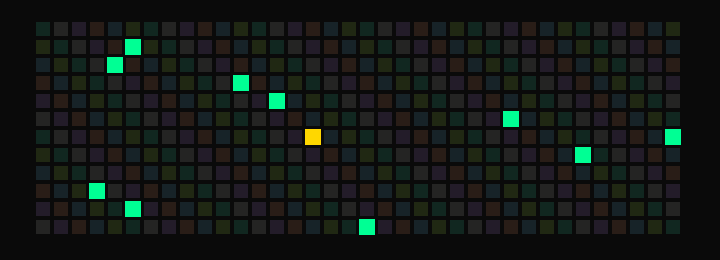
A payout-qualified closed round requests randomness once. Fulfillment stores the result; a separate finalization step resolves the Grand pixel. The configured randomness provider must be verified on Robinhood before public play opens. Quick placement is a separate backend-operated process, not this draw.
The verified owner of the Grand pixel is eligible for the round's canvas NFT. Minting requires a finalized result, a payout-qualified outcome and the pot successfully released to ClaimVault. A refunded round has no winner NFT.
There is one canvas NFT per round, not one NFT per participant. The winner mints from their wallet and pays gas. NFT minting and the ETH prize claim are separate actions. Artwork and metadata currently depend on the application's renderer; immutable artwork storage is not guaranteed.
Claims, deadlines and refunds
- Grand withdrawal
- Credited at funding / no expiry
- Consolation claims / reclaim
- Not available in V4
- Unfilled expired round
- Paid purchase refund
- Unreleased closed-round pot
- 30-day stale-pot refund escape
V4 credits Grand's ETH to a pending withdrawal automatically when the revealed round is funded. The winner uses a withdrawal transaction to receive ETH; no Merkle proof is needed. NFT minting is independent.
The owner cannot reclaim Grand's credited balance. Grand and treasury withdrawals remain reserved with no withdrawal expiry. There is no remaining consolation prize or post-funding reclaim timer. An allocation estimate is not a verified credit or a withdrawable balance.
A refundable round returns the buyer's recorded purchase payment, not gas. A wallet claims its refund once. Free pixels have no paid amount to refund. A finalized-looking cached result cannot override the current on-chain outcome.
For a closed round whose pot has not been released, Core retains a separate 30-day stale-pot refund path. This applies only before the pot reaches the vault; it never expires an existing Grand withdrawal.
Referrals are separate from Crew
A referral links a new referred wallet to its inviter. The agreed earning policy is 3 pixel rights for the inviter after the referred wallet's first confirmed paid purchase, once per referred wallet. Self-referrals do not qualify.
Once the first paid purchase is confirmed and the referral is verified, the inviter can redeem three pixels in an active round without waiting for a draw or pot funding. A later refund of the referred purchase does not revoke the award. Each referred wallet qualifies only once; a refunded bonus round does not restore used pixels. Board capacity, the 250-pixel wallet cap and the 999-referral-pixel round budget still apply.
Different wallet addresses do not prove different people. Referral attribution is verified by a separate backend signer, and multi-wallet farming remains a promotional risk. The public program stays disabled until its live checks and launch limits are approved.
Referral minting is disabled on the hosted release. Crew awards and referral awards are separate, and neither creates a right to withdraw ETH.
Referral activityWhat is verified, and what is trusted
- The contract enforces ownership, capacity, payment and signature replay checks. A signed assignment hash prevents the operator from replacing an already accepted pixel list.
- Quick assignment remains backend-operated. Signatures do not make its selection fully decentralized or prove the backend could not bias a quote.
- Deployment configuration, pot release and treasury operations retain owner/operator trust. V4 resolves Grand from the linked on-chain reveal source, with no prize manifest. That source must itself be verified; a Crew seed alone is not a verified list of Crew winners. A buyback treasury credit does not prove tokens were bought or burned.
- A wallet connection is not proof of ownership. Chat uses one ownership signature per session, not a signature for every message. Chat authorization cannot approve a purchase.
- Game entries carry loss risk. More pixels do not guarantee a win. Testnet or local verification is not a mainnet security guarantee.
Common questions
Does Manual Pick improve my odds?
No per-pixel odds advantage is promised. The premium buys location choice, including drawing positions. Each eligible pixel remains one entry.
Can I keep playing while an older draw is pending?
Yes, when the next round has opened. Each round has independent purchases, randomness, funding and claims. Earlier rewards do not settle inside your new purchase.
Are free pixels the same as $PIXEL tokens?
No. A bonus pixel is an entry on a game board. $PIXEL is a separate token; the canvas NFT is a separate ERC-721 asset.
Is the Crew award already available?
Not on the public release. The new contracts enforce 20 pixels per winning wallet and source round, without stacking. Deployment and the complete mint flow still need verification; examples are not claim proofs.
Does the price change when ETH moves?
No. Quick costs 0.0004 ETH and Manual costs 0.0008 ETH per pixel. Their dollar value can change, but the fixed ETH purchase amount does not. Network gas varies separately.
Does a pixel color prove who owns it?
No. Color is a display aid. The wallet address and confirmed contract state establish ownership.